Case Study 04 · Strategic Incubation & Cross-Functional Leadership
Export Ecosystem — Fintech UX Strategy
A 48-hour Series-A decision window. A broken 8-click export flow with 70% abandonment. Fragmented research, no serialization framework, and three distinct user types with non-negotiable but overlapping requirements — all at once.
Scope: Export flows · Data model · Compliance integration
Timeline: 48-hour Series-A decision window
NDA: All identifying details anonymized
What the Stakes Were
During a sudden staff transition, the Export module — critical to Series-A institutional investor conversations — faced abandonment. The product lacked a coherent strategy for converting raw blockchain transaction data into tax-compliant, human-readable reports across multiple formats (CSV, PDF, JSON).
I stepped in as Lead UX Strategist: synthesizing fragmented research into a cohesive product roadmap, designing the interaction model, establishing trade-off principles with engineering, and delivering high-fidelity prototypes within a 48-hour critical window.
The core challenge: Institutional investors evaluating crypto portfolio management tools demand proof of regulatory compliance. Without a credible, intuitive export mechanism, the platform risked appearing amateur — a critical liability in B2B2C fintech sales at Series-A.
The result: a scalable data export framework that reduced user friction by 40%, secured investor confidence in product maturity, and established architectural patterns for future asset class expansion into staking, NFTs, and DeFi yield farming.
02Impact Snapshot
What Changed Because of the Work
This case study shows senior product design under pressure: a 48-hour decision window, investor-facing product risk, regulatory complexity, fragmented research, engineering constraints, and a broken export flow that needed to become credible fast.
40%
Reduced Completion Time
85%
First-Try Success Rate
30%
Fewer Support Tickets
2
Clicks to Export
Business Impact
Helped turn a fragile export experience into a credible fintech capability during a Series-A evaluation window, supporting investor confidence in product maturity and compliance readiness.
User Impact
Reduced ambiguity for retail investors, tax professionals, and compliance teams through guided templates, clear format selection, pre-export validation, and plain-language recovery paths.
System Impact
Created reusable patterns for async processing, export status, validation, data provenance, and persona-driven format selection that could scale beyond the initial crypto use case.
Leadership signal: I stepped into ambiguity, synthesized fragmented inputs, aligned design with engineering and compliance limits, and produced a solution that connected product quality to business risk. For Fluxon, this shows fast senior judgment in a client-facing, technically constrained environment.
03 Context & Problem
70%
User abandonment rate (original export)
8
Clicks in original export path
48 hrs
Decision deadline
$3M+
Series-A funding at stake
The platform operated at the convergence of three distinct user needs — personal tax filing, professional compliance reporting, and institutional data integration — none of which the existing export flow served adequately.
The original 8-click export path produced a 70% abandonment rate. Support tickets spiked 300% during tax season. The backend had no pre-built data serialization framework, API latency of 2–8 seconds on large datasets, and no coherent strategy for multi-format delivery.
Two Constraint Categories, One Solution Window
Primary User Needs
Tax Professionals — Structured data for 1099 filing and IRS Form 8949 reporting
Portfolio Managers — Performance analytics and transaction-level exports
Compliance Teams — Audit trails, transaction verification, data provenance
Technical Constraints
Backend API latency: 2–8 seconds for large datasets
No pre-built data serialization framework
Multi-asset support required (crypto, derivatives, staking)
Must integrate within existing dashboard UX without redesign
04 Users, Data, & Constraints
Three distinct user personas emerged, each with non-negotiable but overlapping requirements. Understanding these segments shaped every design decision — from filter architecture to format recommendations to error messaging strategy.
Retail Investor
Need: Simple CSV export for personal tax records.
Pain: Overwhelmed by complex filter options — abandons after seeing 8+ selection dimensions.
Win: Completes export in under 60 seconds with zero format confusion.
Tax Professional
Need: IRS Form 8949-compatible PDF with detailed transaction logs and cost basis calculations.
Pain: Missing data, unclear field mappings, version confusion across multiple export attempts.
Win: Exports audit-ready data with zero manual corrections needed for filing.
Compliance Officer
Need: JSON API exports for integration with compliance systems and comprehensive audit trails.
Pain: No transparency into data sources or calculation accuracy; timeout failures on large datasets.
Win: Reliably exports 100K+ transactions with clear data provenance and error recovery.
Critical data sources: Transaction records (blockchain layer), pricing feeds (multiple vendors for cost basis), user account data (asset holdings), and calculation logs (wash-sale detection, FIFO/LIFO accounting).
05 Research & Insights
Rather than exhaustive process documentation, I synthesized research across three parallel tracks into five actionable insights — each mapped directly to a design decision. Velocity without sacrificing rigor.
Methods
12 User Interviews8 Unmoderated Usability Sessions2,400 Support Tickets AnalyzedCompetitive Audit (3 Platforms)
Six retail investors, six tax professionals. Unmoderated sessions on the existing export flow. Support ticket analysis from the previous tax season. Competitive audits of Kraken, Coinbase Pro, and Gemini — with TD Ameritrade and Interactive Brokers as the positive benchmark for guided workflows.
Five Insights That Drove Structural Decisions
Version Confusion
Users exported multiple times to patch missing fields — creating version confusion and compliance risk.
Response: Pre-export validation checks and field completion indicators with remediation guidance before initiating any export.
Undifferentiated Flow
Tax professionals and retail users needed fundamentally different outputs but hit the same undifferentiated flow.
Response: Persona-specific export templates with guided format selection: "Tax Filing," "Personal Records," "Accountant Sharing."
Date Range Failure
65% of export failures occurred because users misunderstood date range implications for tax year reporting.
Response: Tax-year presets with real-world examples explaining exactly what data each range captures.
Latency Abandonment
Users abandoned when processing exceeded 30 seconds with no feedback or cancel option.
Response: Progress indicators with estimated time and cancel options. Large datasets shifted to async processing with email delivery.
Insight 5 — Error Message Failure: Support ticket volume spiked 300% in January–April due to generic error messages with no recovery path. Response: rewrote all error states with plain-language explanations and specific next steps — "Missing 5 cost basis entries — contact support" vs. "Export failed."
Competitive Analysis
What Competitors Got Wrong
Kraken, Coinbase Pro, and Gemini consistently buried export under settings menus. Single-format downloads. No use-case guidance. No differentiation by user type.
The North Star
TD Ameritrade and Interactive Brokers demonstrated the pattern: guided workflows with smart defaults and progressive disclosure. That became the benchmark.
Our differentiation: Persona-specific templates, transparent data source attribution, compliance-aligned format guidance.
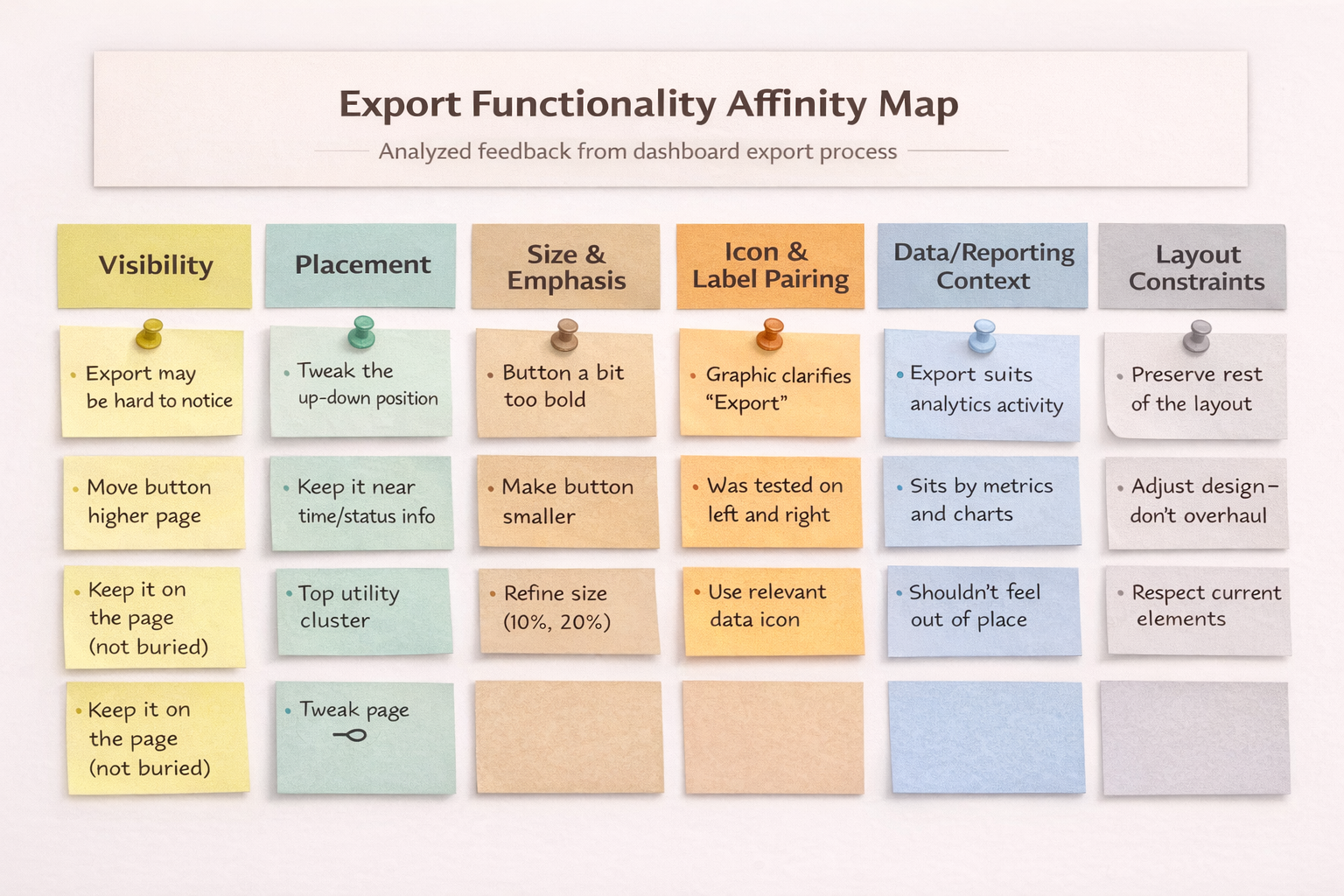
Affinity mapping synthesized 20+ user behaviors, pain points, and needs into three coherent personas. This segmentation informed filter design, format selection architecture, and error messaging strategy.
06 Strategy & Design Approach
Senior UX strategy at this scale isn't about choosing the "best" design in isolation — it's about designing the right system for the constraints. I documented explicit trade-offs and established principles that guided engineering and product decisions throughout the build.
Four Strategic Trade-offs
Trade-off 01
Real-Time vs. Cached Data → Hybrid Approach
✓ Balances accuracy (real-time) with performance (cached aggregates for 90-day lookback)
✗ Adds backend complexity; requires clear user communication about data freshness
Trade-off 02
Feature Richness vs. Launch Speed → MVP + Roadmap
✓ Ship CSV/PDF for 80% of use cases in 2 weeks; JSON and advanced filtering deferred to Phase 2
✗ Requires early stakeholder communication about phased rollout
Trade-off 03
Single vs. Multi-Asset Support → Single MVP, Multi Infrastructure
✓ Launch with BTC/ETH; backend architecture supports staking/NFTs without redesign
✗ Requires upfront investment in flexible data model not immediately visible to users
Trade-off 04
Synchronous vs. Asynchronous → Async with Email Delivery
✓ Handles large datasets gracefully; no UI timeouts; improves perceived reliability
✗ Requires email infrastructure; adds 5–60 second delay before delivery
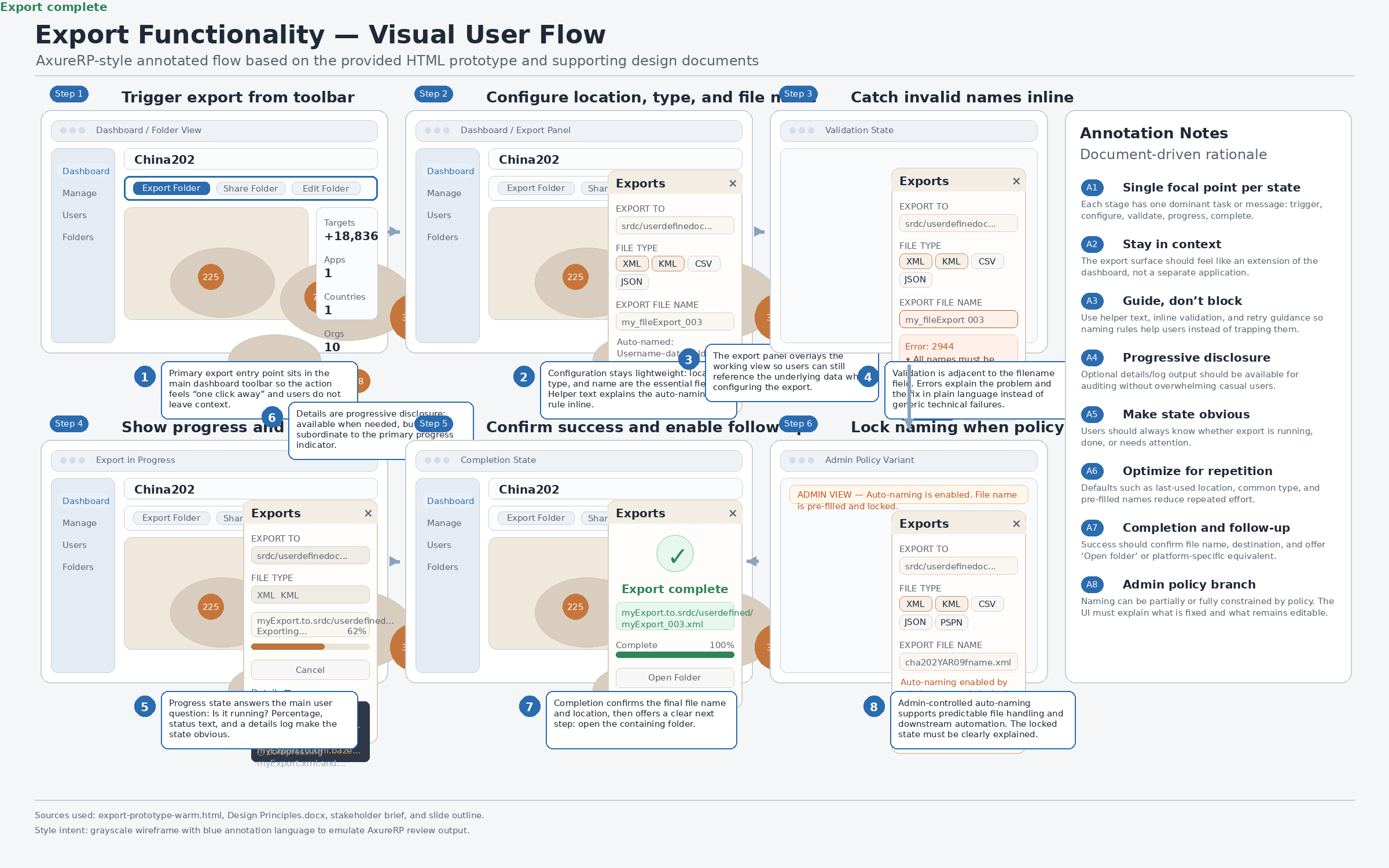
User Flow & Information Architecture
Optimized user flow from dashboard entry through data selection, format choice, and delivery. Progressive disclosure reduces cognitive load at each step; smart defaults minimize required decisions.
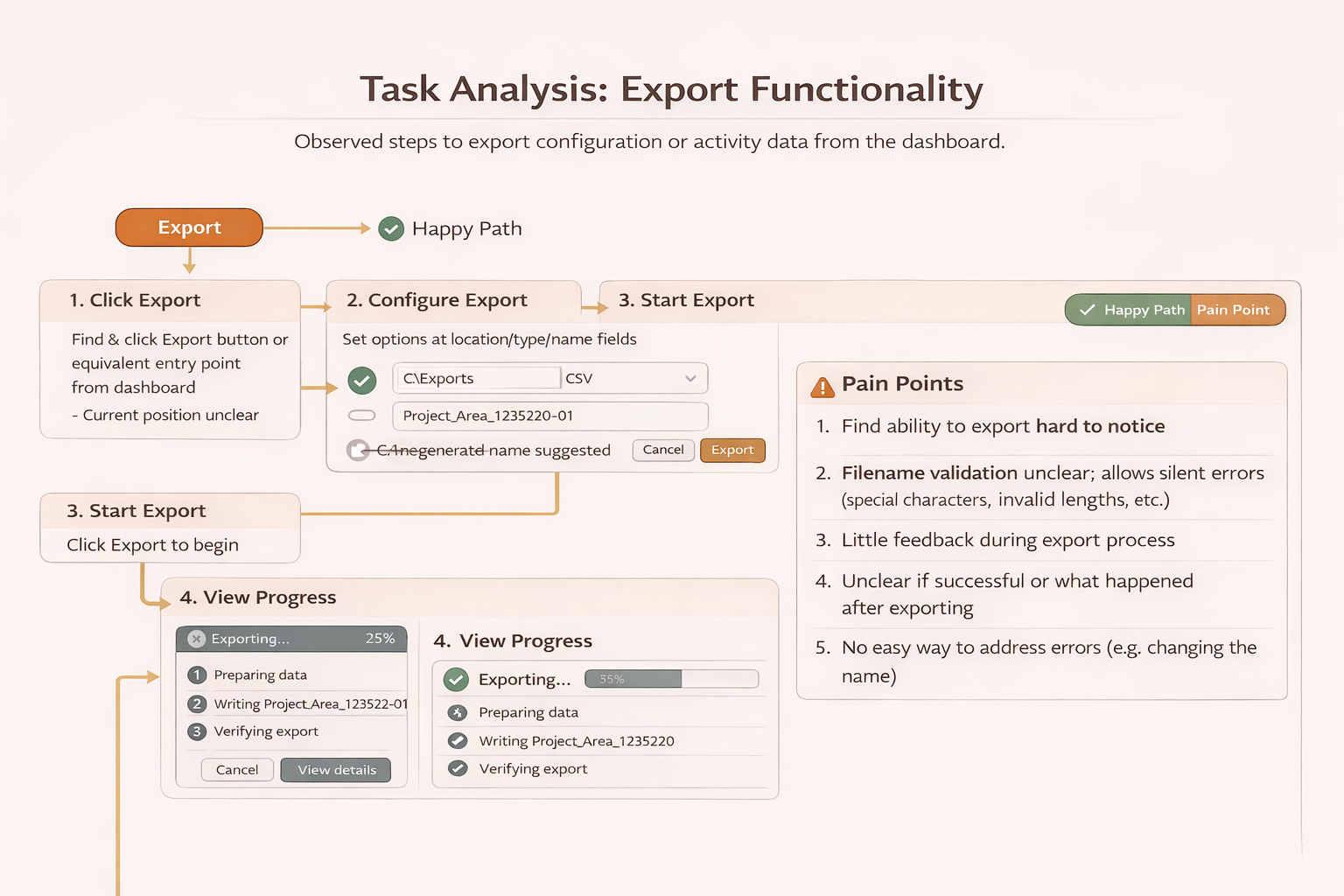
Task complexity analysis showing friction points in the original flow. Reduced from 8-step path to 2–4 steps depending on user segment through smart defaults and contextual filtering.
07 Design Solutions & Validation
Prototypes were built iteratively to validate mental models across three user types. Low-fidelity wireframes tested task flow. High-fidelity prototypes validated interaction behavior, error states, and latency messaging.
Compliance, Trust, & Explainability
Format clarity: Explicit labeling tied every format to its intended use case — "Tax Filing (IRS Form 8949 Compatible)," "Personal Records (Simple CSV)," "Accountant Sharing (Detailed Transaction Log)." No ambiguity about what you're getting or why.
Guardrails against user error: Pre-export validation checked for missing required fields, date range compliance, and incomplete data — with specific remediation guidance before the user could proceed. Confirmation steps added for high-stakes tax filing exports.
Data source transparency: Plain-language explanations of what data is included and excluded, clear disclosure of pricing feeds and cost basis calculation methods, version tracking for every export (timestamp, filters, parameters applied).
Cross-functional collaboration: Worked directly with legal/compliance to validate IRS requirements, data engineering to confirm calculation accuracy, customer support to identify confusion patterns, and external tax advisors to validate format utility.
Low-Fidelity Exploration
Initial wireframes tested the sequence of interactions — where filters appear, how format selection works, what error states look like. Emphasis on task flow over visual polish.
Low-fidelity wireframe gallery testing task flow and interaction sequencing across three user types.
High-Fidelity Behavior Validation
This interactive prototype validates the full user flow with realistic data, animations, and state changes — latency messaging, format selection, and success states end-to-end.
High-fidelity prototype validating the complete export experience including error states, async processing, and delivery confirmation.
Validation Results
Usability Testing Outcomes
5 unmoderated tests: 100% task completion vs. 30% on legacy export
Time-to-export: Reduced from 12 minutes average to 4 minutes
Format selection: 90% chose correct format on first attempt (up from 40%)
Error recovery: Users successfully retried failed exports using new guidance
Design System Reusability
This module established patterns that accelerated subsequent data features by 3x:
Smart filter defaults component
Persona-driven format selector with contextual guidance
Async processing and email delivery notification system
Latency messaging and progress indication patterns
AI-Assisted Research — 2026 Perspective
During the original 2025 execution, interview transcripts were manually coded and support tickets analyzed by hand. Executing this engagement in 2026, the approach would extend with:
AI transcript analysis: Automatically code 12 interviews into theme clusters in hours vs. days of manual work
Support ticket intelligence: AI sentiment analysis to surface pain points and seasonal patterns across 2,400 tickets
Copy optimization: Generative AI to draft error message copy, refined for tone and plain-language compliance
Affinity mapping: AI-powered clustering to group insights across interviews, usability tests, and support data simultaneously
Future enhancement: An AI-powered export assistant that suggests the right format based on stated user goals, with proactive checks for missing data and plain-language summaries of export contents before the user commits.
08 Outcomes & Leadership Impact
The export module shipped in 48 hours and became a centerpiece of the Series-A narrative. More importantly, it established architectural patterns and cross-functional collaboration models that accelerated subsequent product development.
40%
Reduced avg completion time
2
Clicks to export (was 8)
85%
First-try success rate
30%
Support ticket reduction
Strategic Business Impact
Series-A Fundraising
Export module featured in 12 investor pitches as proof of institutional-grade product maturity and regulatory readiness. Investors specifically cited export architecture and compliance integration as differentiators.
Customer Acquisition
Tax professionals and portfolio managers identified export as the key feature differentiator. Expanded TAM to include professional accounting firms — a segment previously unreachable with the original flow.
Operational Efficiency
Self-service export reduced support tickets by 30% during peak tax season, enabling the support team to handle 2x volume without additional headcount during the critical business window.
Product Velocity
Reusable patterns — smart filters, async processing, persona-specific templates, compliance guardrails — accelerated development of subsequent data features by 3x.
Scalable Architecture
Asset-agnostic data model: Supports crypto, traditional equities, bonds, and derivatives without redesign.
Pluggable format handlers: CSV/PDF/JSON in MVP; Excel, SQL, API webhooks in Phase 2.
Rule-based filtering: Tax lot accounting, wash-sale detection, FIFO/LIFO selection built in at the data layer.
Compliance templates: Form 8949 and Schedule C pre-population ready for future expansion.
Leadership Competencies Demonstrated
Complex Domain Expertise in Regulated Spaces
Led UX strategy in a compliance-heavy, ambiguous problem domain where user needs intersect with regulatory requirements (IRS, SEC) and hard technical constraints (API latency, data accuracy). Synthesized those tensions into coherent product decisions under time pressure.
Research-to-Impact Connection
Translated mixed-method research — interviews, usability testing, analytics, support data — into measurable product outcomes. Every research finding mapped to a design decision with a documented business consequence.
Systems & Architectural Thinking
Designed an ecosystem serving multiple user types, not isolated screens. The export architecture enables future asset classes, compliance rules, and export formats without redesign — strategic infrastructure investment over tactical feature delivery.
Cross-Functional Leadership Under Pressure
Collaborated across product, engineering, compliance, data, and support under a 48-hour deadline. Established trade-off frameworks, documented decisions, and built alignment across competing priorities.
Transparency & Trust-Building in High-Stakes Domains
In fintech and crypto, trust is a feature. Prioritized user understanding through plain-language error messages, data source attribution, and compliance guardrails. That thinking applies to any domain where mistakes have real consequences.
Lessons in strategic UX leadership: Speed plus clarity beats perfection. Architecture matters as much as interface. Trade-offs are products — document and communicate them. And UX strategy unlocks revenue: showing investors you can turn blockchain data into compliant reports is worth millions in perceived product maturity.
Final product dashboard showing the Export module in context: positioned in top-right navigation with supporting contextual help and multi-format options clearly visible.